Volatility Is the Point
Michael Saylor turned a stagnant software company into a Bitcoin machine. One of its stranger creations is STRC — a preferred stock engineered to stand still at $100 while everything around it moves.
Recently a good friend mentioned that she and her husband were looking to buy a condo as an investment. It reminded me of a unit I'd been watching for about two years in the Lakewood Ranch area of Sarasota, Florida.
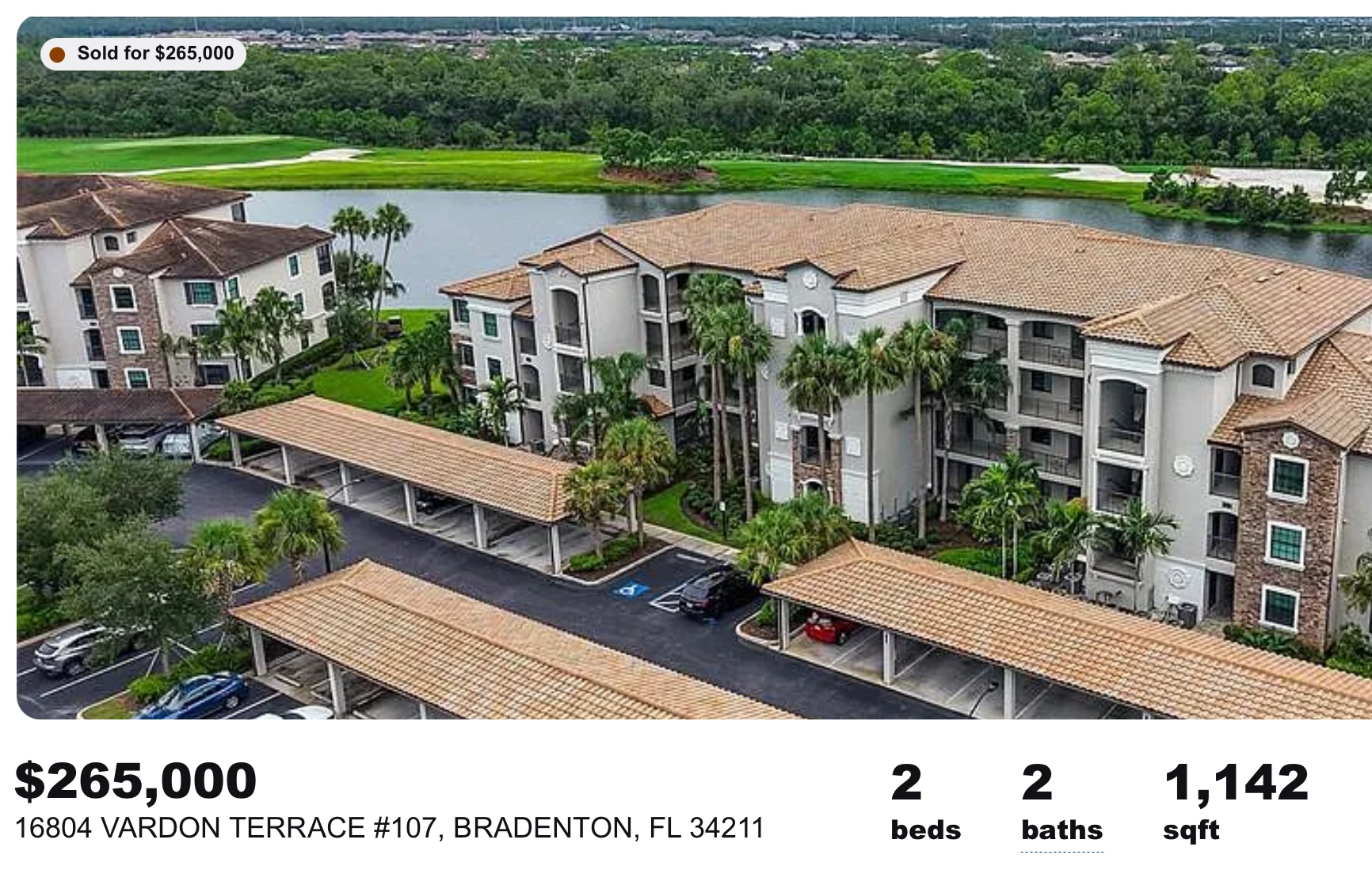
It's a 2-bedroom, 2-bath on a golf course, inside a gated community built around two of the nicest courses in the area, including Lakewood National. Fully furnished, with a solid rental history, it was originally listed at $449,000. Over the next two years — from around 2023–2024 until about a month ago — the price kept falling, all the way down to $270,000, with the owner willing to discuss owner financing.
The longer it sat, the more motivated the owner got to get it off their books — and it finally sold for $265,000. According to Zillow, a traditional mortgage on it would run about $3,139 a month at today's rates — a 30-year fixed around 7.5%. That breaks down to roughly $1,536 in principal and interest, $1,163 for the HOA, and another $440 in taxes, insurance, and other costs. The HOA is steep, but it includes a golf membership — if you're a serious golfer, you'd pay that anyway to join the club in that neighborhood, so here it's simply baked in.
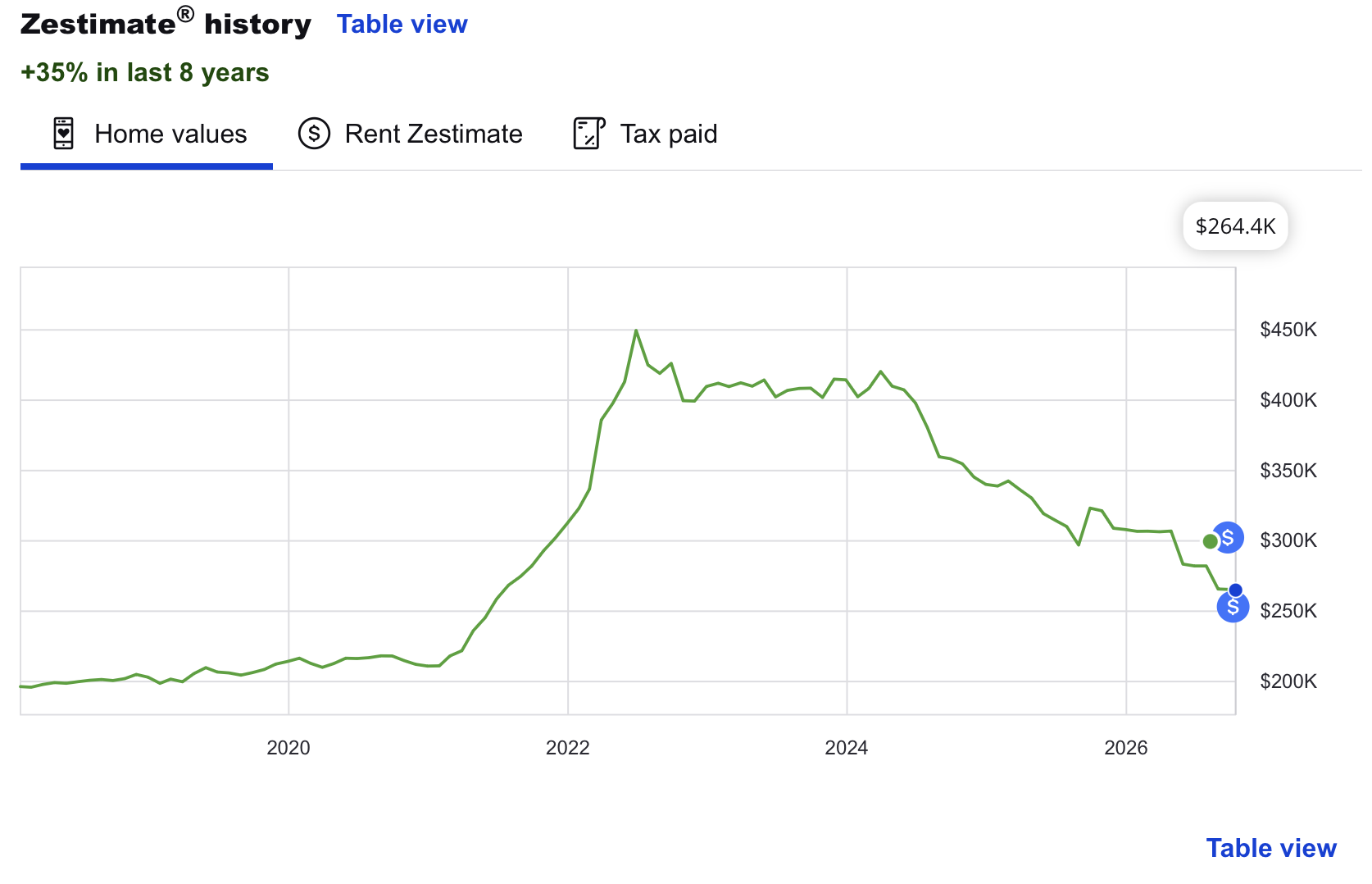
And this isn't just a number I'm making up. Here is Zillow's own Zestimate history for the unit: it ran up to nearly $450,000 at the 2022 peak and has drifted down ever since, with a Zestimate of about $264,000 today — right about what it actually sold for, $265,000. That is the backdrop for everything that follows.
The investment I want to talk about is a preferred stock issued by Strategy — formerly MicroStrategy — the company founded by Michael Saylor. Saylor earned a double major at MIT in aeronautics and astronautics and in the history of science. MicroStrategy began as an enterprise software-as-a-service company, selling tools that let businesses analyze big data and understand their own operations.
Back in the second quarter of 2020 — the early days of the COVID lockdown — Saylor had $500 million in cash sitting on MicroStrategy's balance sheet, and he started asking what the best use of it was. The software business wasn't growing. It was stagnant, and he didn't think its long-term prospects were strong, so he went looking for the highest-returning place to put that cash.
MicroStrategy was then — and still is, under the Strategy name — a publicly held company, which carries a fiduciary responsibility to deploy that cash for the highest rate of return. Saylor looked at everything: returning it to shareholders as a dividend, acquiring other companies, reinvesting in the existing business, real estate, and on and on. In the end he concluded that the only investment worth making was Bitcoin — and that's what he did.
He bought $500 million of Bitcoin, and he has been issuing debt and stock ever since for the sole purpose of buying more. That is why the company changed its name from MicroStrategy to Strategy: the strategy is to buy Bitcoin. Saylor is convinced the price is headed into the millions per coin, and that Bitcoin is the best asset anyone can hold — his company included. Through Strategy, he has since accumulated more than 848,000 Bitcoin at an average cost of about $75,000 per coin — roughly $64 billion invested — a position worth around $69 billion as of October 2026.
Strategy has issued several different classes of stock, each designed to give investors exposure to a different aspect of Bitcoin's price growth. One of those aspects — the one that turns most people off — is its extreme volatility: the price swings wildly up and down.
I find it funny how often that comes up. Whenever I discuss Bitcoin or cryptocurrency as an investment, the response is almost always the same: "Oh no, that stuff's too volatile."
But volatility is the only thing that produces returns. An investment without volatility is a money market fund or a CD — your principal doesn't grow. You collect 3% or 4% interest, and once you account for inflation and the government printing money, the usual analysis says you need at least 10% or 11% a year just to keep pace with the growth of the money supply. Earn less than that and you're losing money in real terms. Earn more — say 15% against an 11% hurdle rate — and you're netting only 4% of real growth.
Enter Stretch (STRC)
Saylor has created a number of these stocks. One of them is called Stretch, ticker symbol STRC, which began trading in late July 2025 at an IPO price of $90 and is designed to trade at around $100.
And that is more or less what it has done. Apart from a sharp dip in June 2026, STRC has spent its whole life hugging its $100 par — the opposite of the volatility people complain about in Bitcoin itself.
That June 2026 dip was the one real scare. STRC fell to an intraday low of $71.25 — a roughly 25% drop on an instrument that is supposed to sit at $100. Strategy's CEO, Phong Le, walked through what happened in an interview worth watching: investors had been borrowing against their Bitcoin at around 6% to collect STRC's roughly 12% yield, and when Bitcoin sold off, that leverage unwound. Margin calls forced those holders to dump STRC, and the price fell with it — until the company stepped in with buybacks and it climbed back toward par. In my opinion, that round trip — from $98.99 down to an intraday $71.25 and back to $98 or $99 inside about sixty days — should actually be reassuring. It was a stress test, and STRC passed: the instrument absorbed a violent, leverage-driven selloff and recovered. If something like that happens again, the history now suggests it recovers again. And the moves the company has made in the days since — adding the buyback program and shifting to a daily cash dividend — are all designed to build more liquidity and more price stability. Each future dislocation, if there even is one, should be less severe than the last.
And that gets at the whole point of the design: Strategy has a stack of levers it can pull to keep STRC pinned near its $100 target. The buybacks and the daily dividend are two of them — but the main one is the variable dividend itself. When the share price slips below par, Strategy simply raises the dividend rate to pull buyers back in: a fatter yield makes the stock more attractive, demand picks up, and the price gets nudged back toward $100. You can watch that lever being pulled in the dividend itself — the rate has done nothing but climb since the IPO, from 9% to 12%.
Saylor makes the case for all of this himself. Here he walks through Strategy's lineup of preferred shares — STRK, STRD, STRF, and STRC — and how they turn a Bitcoin treasury into a stream of dividends.
What Stretch (STRC) is actually good for
I started thinking about what this means for real people. I have two retired friends, and one of their biggest complaints about retirement is the same: both have sizable 401(k) and IRA balances, but they have to pay themselves out of those accounts to live. One of them does it every quarter — selling investments out of the IRA or 401(k) to draw the same income they earned in a working quarter, just to keep their lifestyle where it was before they retired. The other does it as needed, when a trip or some other big-ticket purchase comes up.
Either way, they have to sell something. And selling means decisions: what to sell, which account to sell it out of — the IRA, the 401(k), a trust — and what the tax consequences are. Sometimes it triggers a taxable event, which is just annoying. Taxes are always annoying.
Now line that up against Stretch. Put $1 million into STRC at a 12% dividend and you collect $120,000 a year — paid to you in cash, daily. That's about $330 landing in your checking account every day. No selling, no deciding what to sell or which account to pull it from, no quarterly tax gymnastics. Just liquidity.
Here's the part that makes it interesting: the dividend is treated as a return of capital. Under IRS rules, a return of capital is tax-deferred — you don't pay tax on the cash dividends until your cost basis reaches zero. "Cost basis reaches zero" simply means you've received back, in cash, the full amount you originally put in — $1 million in the example above, or $270,000 if you're comparing it to the condominium purchase I opened with.
At a 12% dividend, that takes about 8.4 years. So for roughly 8.4 years, the cash landing in your account every day arrives tax-deferred. Only after that — 8.4 years from the day you invest — do you start paying taxes on the dividends you receive.
(The daily payment depends on Strategy's proposed daily-dividend transition, which goes to a vote on October 28 and would take effect November 2, 2026. I fully expect it to pass.)
What a great way to fund your living expenses in retirement.
$270,000, two ways
Put the two side by side. That condo sold for $265,000 — call it $270,000 all-in.
Say you buy it with cash and rent it out, and give it every benefit of the doubt: assume it rents for roughly what Zillow figures the all-in payment at, about $3,139 a month, or $37,700 a year. Out of that you still owe the HOA, the taxes, and the insurance — about $1,600 a month, $19,000 a year. That leaves you a net of roughly $1,536 a month, call it $18,400 a year: a return of about 6.8% on your $270,000. And it's ordinary taxable rental income — before you account for vacancies, repairs, management, and the plain hassle of being a landlord. Your capital is tied up, too. The only ways to get it back out are to sell or to remortgage the property — and a cash-out refinance just loads a mortgage payment and interest right back on top, eating straight into that already-thin cash flow.
Now put that same $270,000 into STRC. At a 12% dividend you collect about $32,400 a year — roughly $2,700 a month, about $89 a day — paid to you in cash. Because that dividend is treated as a return of capital, it's tax-deferred until your cost basis reaches zero, which at 12% takes a little over eight years. No tenants, no repairs, no closing costs to get out — the money stays completely liquid.
So the condo's best case — fully rented, bought with cash — nets you around $18,400 a year of taxable income. The same quarter-million in STRC pays about $32,400 a year, tax-deferred, with none of the work and none of the lockup. That's roughly $14,000 more a year, in cash, for doing nothing.
Not drawing on it yet? Let it compound
And it gets better if you don't need the income today. Say retirement is still ten years off. Instead of spending the dividends, you reinvest them — every payment (twice a month today, and daily once the November 2 change takes effect) buys more STRC. Your share count keeps growing, the balance compounds, and each dividend is then paid on a larger position than the one before.
Run the numbers. Put that same $270,000 in today at 12%, reinvest every dividend as it's paid, and in ten years it compounds to roughly $896,000 — more than three times what you started with, without adding a single dollar.
The income grows right alongside the balance. The daily cash that started at about $89 a day would be running near $295 a day by the time you retire — on a stake that more than tripled while you weren't touching it. The same mechanism that makes STRC a clean income stream in retirement makes it a compounding machine on the way there.
Nobody's taking a cut
Here's something that gets lost in all of this: there is no management fee. No Wall Street fund fee, no mutual-fund expense ratio, no annual drag skimmed off the top. STRC may be one of the most innovative investments to come along since the mutual fund itself — and unlike most of what Wall Street dreams up, it wasn't built to generate fees.
Because that's usually the real motive. Most investment "innovations" exist to create a new stream of fee income for Wall Street, whether or not the customer ever comes out ahead — the fund, the wrapper, the share class, somebody clipping a percentage every year. On STRC there is none of that. It's pure: you put money in, you get money out. And with $0 commissions on stock trades now standard across the industry, you incur essentially no charge to buy it, hold it, or sell it — unlike the ever-popular mutual fund, the ETF, or whatever Wall Street dreams up next.
Where this is heading
STRC is an early example of what some are calling digital credit — one of the newest and, to my mind, most innovative advancements in finance in a long time. Put everything we've covered in one place: liquidity you can tap any day, a double-digit yield, cash dividends paid daily, return-of-capital treatment that defers the tax bill for years, and no management fees or fund expenses skimming off the top — all wrapped around a price engineered to sit near $100 instead of swinging with Bitcoin.
That is a fundamentally different package than anything Wall Street has handed the ordinary investor before. In my opinion, instruments like this — high-yield, liquid, tax-advantaged, and fee-free — are going to become extremely popular and very common over the next five years. STRC won't be the last of its kind; it's the leading edge of it.
And set it against the condo we opened with: $265,000 that costs you money to hold, ties up your capital, and makes you a landlord — versus the same money paying you daily, staying liquid, and compounding if you let it. For a lot of income investors, that is not going to be a close call.
This is not financial advice — it's one person's analysis, not a recommendation. Always do your own homework before you invest a dollar.